
Space exploration is the use of astronomy and space technology to explore outer space. Physical exploration of space is conducted both by human spaceflights and by robotic spacecraft. While the observation of objects in space, known as astronomy, predates reliable recorded history, it was the development of large and relatively efficient rockets during the early 20th century that allowed physical space exploration to become a reality. Common rationales for exploring space include advancing scientific research, uniting different nations, ensuring the future survival of humanity and developing military and strategic advantages against other countries. Various criticisms of space exploration are sometimes made.
Space exploration has often been used as a proxy competition for geopolitical rivalries such as the Cold War. The early era of space exploration was driven by a "Space Race" between the Soviet Union and the United States, the launch of the first man-made object to orbit the Earth, the USSR's Sputnik 1, on October 4, 1957, and the first Moon landing by the American Apollo 11 craft on July 20, 1969 are often taken as the boundaries for this initial period. The Soviet space program achieved many of the first milestones, including the first living being in orbit in 1957, the first human spaceflight (Yuri Gagarin aboard Vostok 1) in 1961, the first spacewalk (by Aleksei Leonov) in 1965, the first automatic landing on another celestial body in 1966, and the launch of the first space station (Salyut 1) in 1971.
After the first 20 years of exploration, focus shifted from one-off flights to renewable hardware, such as the Space Shuttle program, and from competition to cooperation as with the International Space Station.
From the 1990s onwards, private interests began promoting space tourism and then private space exploration of the Moon.
In the 2000s, the People's Republic of China initiated a successful manned spaceflight program, while the European Union, Japan, andIndia have also planned future manned space missions. The United States has committed to return to the Moon by 2018 and later Mars.China, Russia, Japan, and India have advocated manned missions to the Moon during the 21st century, while the European Union has advocated manned missions to both the Moon and Mars during the 21st century.

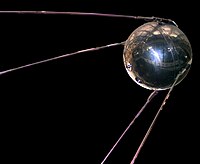
- First Flights
This success led to an escalation of the American space program, which unsuccessfully attempted to launchVanguard 1 into orbit two months later. On January 31, 1958, the U.S. successfully orbited Explorer 1 on a Juno rocket. In the meantime, the Soviet dog Laika became the first animal in orbit on November 3, 1957.The first successful orbital launch was of the Soviet unmanned Sputnik ("Satellite I") mission on October 4, 1957. The satellite weighed about 83 kg (184 pounds), and is believed to have orbited Earth at a height of about 250 km (150 miles). It had two radio transmitters (20 and 40 MHz), which emitted "beeps" that could be heard by radios around the globe. Analysis of the radio signals was used to gather information about the electron density of the ionosphere, while temperature and pressure data was encoded in the duration of radio beeps. The results indicated that the satellite was not punctured by a meteoroid. Sputnik 1 was launched by an R-7 rocket. It burned up upon re-entry on January 3, 1958.
- First human flights
The first successful human spaceflight was Vostok 1 ("East 1"), carrying 27 year old Russian cosmonaut Yuri Gagarin on April 12, 1961. The spacecraft completed one orbit around the globe, lasting about 1 hour and 48 minutes. Gagarin's flight resonated around the world; it was a demonstration of the advanced Soviet space program and it opened an entirely new era in space exploration: human spaceflight.

The U.S. first launched a person into space within a month of Vostok 1 with Alan Shepard's suborbital flight inMercury-Redstone 3. Orbital flight was achieved by the United States when John Glenn's Mercury-Atlas 6orbited the Earth on February 20, 1962.
Valentina Tereshkova, the first woman in space, orbited the Earth 48 times aboard Vostok 6 on June 16, 1963.
China first launched a person into space 42 years after the launch of Vostok 1, on October 15, 2003, with the flight of Yang Liwei aboard the Shenzhou 5 (Spaceboat 5) spacecraft.
- First planetary explorations
The first artificial object to reach another celestial body was Luna 2 in 1959. The first automatic landing on another celestial body was performed by Luna 9 in 1966. Luna 10 became the first artificial satellite of another celestial body.
The first manned landing on another celestial body was performed by Apollo 11 in its lunar landing on July 20, 1969.
The first successful interplanetary flyby was the 1962 Mariner 2 flyby of Venus (closest approach 34,773 kilometers). Flybys for the other planets were first achieved in 1965 for Mars by Mariner 4, 1973 for Jupiter by Pioneer 10, 1974 forMercury by Mariner 10, 1979 for Saturn by Pioneer 11, 1986 for Uranus by Voyager 2, and 1989 for Neptune by Voyager 2.
The first interplanetary surface mission to return at least limited surface data from another planet was the 1970 landing ofVenera 7 on Venus which returned data to earth for 23 minutes. In 1971 the Mars 3 mission achieved the first soft landing on Mars returning data for almost 20 seconds. Later much longer duration surface missions were achieved, including over 6 years of Mars surface operation by Viking 1 from 1975 to 1982 and over 2 hours of transmission from the surface of Venus by Venera 13 in 1982 (the longest ever Soviet planetary surface mission).
- Key people in early space exploration
The dream of stepping into the outer reaches of the Earth's atmosphere was driven by rocket technology. The German V2 was the first rocket to travel into space, overcoming the problems of thrust and material failure. During the final days of World War II this technology was obtained by both the Americans and Soviets as were its designers. The initial driving force for further development of the technology was a weapons race for intercontinental ballistic missiles (ICBMs) to be used as long-range carriers for fast nuclear weapon delivery, but in 1961 when USSR launched the first man into space, the U.S. declared itself to be in a "Space Race" with Russia.

No comments:
Post a Comment